How SentinelOne's AI Stopped a CPU-Z Supply Chain Attack: Q&A
On April 9, 2026, cybersecurity faced a stark reminder of how sophisticated supply chain attacks have become. Threat actors compromised the official CPUID website (cpuid.com) at the API level, silently redirecting legitimate download requests for CPU-Z to attacker-controlled infrastructure. For about 19 hours, users who downloaded CPU-Z from the official site received a properly signed binary bundled with malicious payload. SentinelOne’s AI-powered EDR agent, however, detected the anomaly within seconds, autonomously terminating and quarantining the threat. This Q&A delves into the attack, how SentinelOne stopped it, and the broader implications for software supply chain security.
Jump to a question:
- What exactly happened in the CPU-Z watering hole attack?
- Why did CPU-Z users trust the infected download?
- How did SentinelOne's AI detect the attack?
- What specific behavioral indicators triggered the alert?
- How does this attack fit into the larger trend of supply chain compromises?
- What can organizations do to protect against such threats?
What exactly happened in the CPU-Z watering hole attack?
On April 9, 2026, the official CPUID website (cpuid.com) was compromised at the API level. Attackers silently redirected legitimate download requests for CPU-Z, HWMonitor, and other tools to attacker-controlled infrastructure. The attack ran for approximately 19 hours. Users who navigated directly to the official site and clicked the download button received what appeared to be a genuine, properly signed binary. However, it contained a malicious payload inside. The threat actors leveraged the trust users had in the vendor's official infrastructure to deliver malware, effectively turning a trusted download source into a weapon. This incident underscores a key vulnerability: even when users follow best practices—downloading only from official sites—they can still fall victim if those sites are compromised at a deep technical level.

Why did CPU-Z users trust the infected download?
CPU-Z, HWMonitor, HWMonitor Pro, and PerfMonitor are staples in IT toolkits, widely trusted by system administrators, overclockers, and IT professionals. Users who downloaded the infected binary followed every instruction they'd been given for safe software acquisition: they navigated to the official website, used the official download button, and received a binary with a valid digital signature from the vendor. The trust chain broke not at the user level but within the supplier's own infrastructure. The attackers didn't tamper with the code in transit; they compromised the API that served the legitimate files. This made the attack exceptionally insidious because there were no obvious red flags for the user. The identity of the trusted developer (CPUID) became the attack vector—a systemic shift highlighted in SentinelOne's Annual Threat Report.
How did SentinelOne's AI detect the attack?
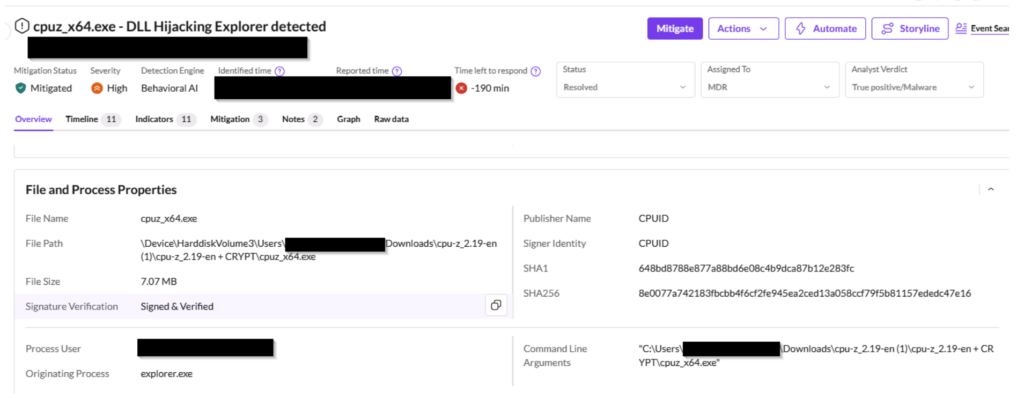
SentinelOne's behavioral detection flagged an anomaly inside cpuz_x64.exe within the first seconds of execution. The binary was genuine, the digital signature was valid, and the download had arrived from the vendor's own infrastructure. However, the agent didn't rely on signature-based detection; it monitored the process chain for abnormal behavior. The telltale sign was that cpuz_x64.exe spawned PowerShell, which then spawned csc.exe (the C# compiler), which in turn spawned cvtres.exe. CPU-Z does not perform these actions under normal circumstances. This chain was part of the malicious payload's execution flow. The SentinelOne agent autonomously terminated and quarantined the involved processes before the attack could advance further. The detection was based on five specific behavioral indicators converging, not on a known malware signature.
What specific behavioral indicators triggered the alert?
The SentinelOne agent triggered an alert titled "Penetration framework or shellcode was detected" because of five converging behavioral indicators:
- Anomalous API resolution: The process located system functions through non-standard discovery methods, bypassing the OS loader entirely.
- Reflective code loading: Executable code was running in memory regions with no corresponding file on disk.
- Suspicious memory allocation: Read-Write-Execute (RWX) memory permissions were requested—a classic staging pattern for malicious payloads.
- Process injection patterns: Execution flow consistent with code being redirected into a secondary process to mask its origin.
- Heuristic shellcode signatures: Sequential operations characteristic of automated exploitation toolkits preparing an environment for command execution.
By analyzing these runtime behaviors, the AI EDR agent could identify the attack without ever needing a signature or prior knowledge of the malware. The agent autonomously terminated and quarantined the involved processes, including the malicious CRYPTBASE.dll that was placed as part of the attack payload.
How does this attack fit into the larger trend of supply chain compromises?
SentinelOne's Annual Threat Report identifies a systemic shift: the identity of a trusted developer becomes the vector of attack. The CPUID incident extends this pattern from code repositories to software distribution itself. In late 2025, the GhostAction campaign saw a compromised GitHub maintainer account push malicious workflows to extract secrets. Another concurrent attack involved phishing against a maintainer of popular NPM packages, deploying code that intercepted cryptocurrency transactions. In both cases, commit logs and push events appeared legitimate because they originated from accounts with valid write access—the identity was verified, but the intent had been subverted. The CPUID waterhole attack is the natural evolution: compromising the supplier's download infrastructure to deliver malware directly to end users. The next attack will work the same way, exploiting trust relationships at the infrastructure level.
What can organizations do to protect against such threats?
Organizations must recognize that traditional security measures—such as verifying digital signatures, using reputable sources, and trusting vendor infrastructure—are no longer sufficient. Supply chain attacks targeting official download channels require runtime behavioral detection capable of spotting malicious activity even when the binary is legitimate and signed. Deploying AI-powered endpoint detection and response (EDR) solutions that monitor process chains, memory allocation, and API usage in real time is critical. Additionally, organizations should enforce least-privilege policies, restrict execution of scripting engines like PowerShell where possible, and maintain robust incident response playbooks specifically for supply chain scenarios. User education should include awareness that even trusted sources can be compromised. The CPU-Z incident demonstrates that autonomous prevention—not just detection—must be the goal, as the attack window may be only hours.